
3. Methods
Yuki Atsusaka and Seo-young Silvia Kim
Source:vignettes/v3-bias-correction.Rmd
v3-bias-correction.RmdEstimating the Proportion of Random Responses
In the identity dataset, given
anc_correct_identity, the raw proportion of those who have
correctly or incorrectly answered the anchor question is as follows:
round(prop.table(table(identity$anc_correct_identity)) * 100, digits = 1)##
## 0 1
## 30.3 69.7The 69.7% seen here, however, is likely an upwardly biased estimate
of the percentage of non-random responses, because we must account for
respondents accidentally answering the question correctly. For an
unbiased estimate of random responses, we use
unbiased_correct_prop.
identity$random_identity <- case_when(
  identity$anc_correct_identity == 1 ~ 0,
  TRUE ~ 1
)

unbiased_correct_prop(
  sum(identity$random_identity == 0) / sum(!is.na(identity$random_identity)),
  J = 4
)
## [1] 0.6836776The revised estimate of non-random responses is 68.4%. That is to say, roughly 31.6% of the respondents are randomly responding.
Direct Bias Correction via imprr_direct
rankingQ has two primary functions to perform bias
correction. First, imprr_direct improves
ranking data by applying direct bias
correction to several classes of quantities of interest.
To apply the bias correction, we specify our dataset
(data), the number of items (J), the columns
holding the marginal ranks for the target ranking question
(main_q), and the indicator for answering the anchor
ranking question correctly (anc_correct). When survey
weights are available, they can be included by specifying
weight in the function.
## party, religion, gender, and race hold the marginal rank of each item

# Perform bias correction
out_direct <- imprr_direct(
  data = identity,
  ## Not strictly necessary: when `main_q` lists the ranking columns,
  ## J is inferred from their number
  J = 4,
  main_q = c("party", "religion", "gender", "race"),
  anc_correct = "anc_correct_identity",
  # setting to 10 only for our vignette
  n_bootstrap = 10
)
## No weight column supplied; using equal weights for all observations.By default, imprr_direct assumes that the target
population is a set of non-random respondents. When researchers wish to
study the entire population as a target group, additional arguments must
be specified, including population and
assumption. For example, the uniform preference assumption
can be specified as follows:
# Bias correction for the entire population with the uniform assumption

out_direct_uniform <- imprr_direct(
  data = identity,
  J = 4,
  main_q = c("party", "religion", "gender", "race"),
  anc_correct = "anc_correct_identity",
  population = "all",
  assumption = "uniform",
  n_bootstrap = 10
)
## population = 'all' with assumption = 'uniform' implies no correction; ignoring anc_correct and p_random.## No weight column supplied; using equal weights for all observations.Similarly, the contaminated sampling assumption can be specified as follows:
# Bias correction for the entire population with contaminated sampling

out_direct_contaminated <- imprr_direct(
  data = identity,
  J = 4,
  main_q = c("party", "religion", "gender", "race"),
  anc_correct = "anc_correct_identity",
  population = "all",
  assumption = "contaminated",
  n_bootstrap = 10
)
## No weight column supplied; using equal weights for all observations.Results: Estimated Proportion of Random Responses
The first output of imprr_direct is the estimated
proportion of random responses. The vector est_p_random
returns the estimated proportion along with the lower and upper ends of
its corresponding 95% confidence interval.
# Estimated proportion of random responses with a 95% CI
out_direct$est_p_random
## mean lower upper
## 1 0.3158402 0.2875352 0.3451338Results: Estimated Quantities of Interest
The other output is the bias-corrected estimates of four classes of ranking-based quantities, including
- average ranks
- pairwise ranking probabilities
- top-k ranking probabilities
- marginal ranking probabilities
The output tibble qoi stores the estimated quantities
and their corresponding 95% CIs.
# View the results based on the quantity of interest
out_direct$results %>%
  filter(qoi == "average rank")
## # A tibble: 4 × 6
## item qoi outcome mean lower upper
## <chr> <chr> <chr> <dbl> <dbl> <dbl>
## 1 gender average rank Avg: gender 1.66 1.61 1.74
## 2 party average rank Avg: party 3.27 3.21 3.30
## 3 race average rank Avg: race 2.48 2.42 2.53
## 4 religion average rank Avg: religion 2.60 2.49 2.66## # A tibble: 11 × 6
## item qoi outcome mean lower upper
## <chr> <chr> <chr> <dbl> <dbl> <dbl>
## 1 party average rank Avg: party 3.27 3.21 3.30
## 2 party marginal ranking Ranked 1 0.0427 0.0309 0.0638
## 3 party marginal ranking Ranked 2 0.151 0.133 0.171
## 4 party marginal ranking Ranked 3 0.304 0.289 0.336
## 5 party marginal ranking Ranked 4 0.503 0.488 0.520
## 6 party pairwise ranking v. gender 0.109 0.0807 0.143
## 7 party pairwise ranking v. race 0.266 0.257 0.287
## 8 party pairwise ranking v. religion 0.359 0.335 0.382
## 9 party top-k ranking Top-1 0.0427 0.0309 0.0638
## 10 party top-k ranking Top-2 0.194 0.172 0.213
## 11 party top-k ranking Top-3 0.497 0.480 0.512For example, one can visualize the result for average ranks as follows:
# Plot the result
out_direct$results %>%
  mutate(
    item = factor(
      item,
      levels = c("party", "religion", "gender", "race")
    )
  ) %>%
  plot_avg_ranking()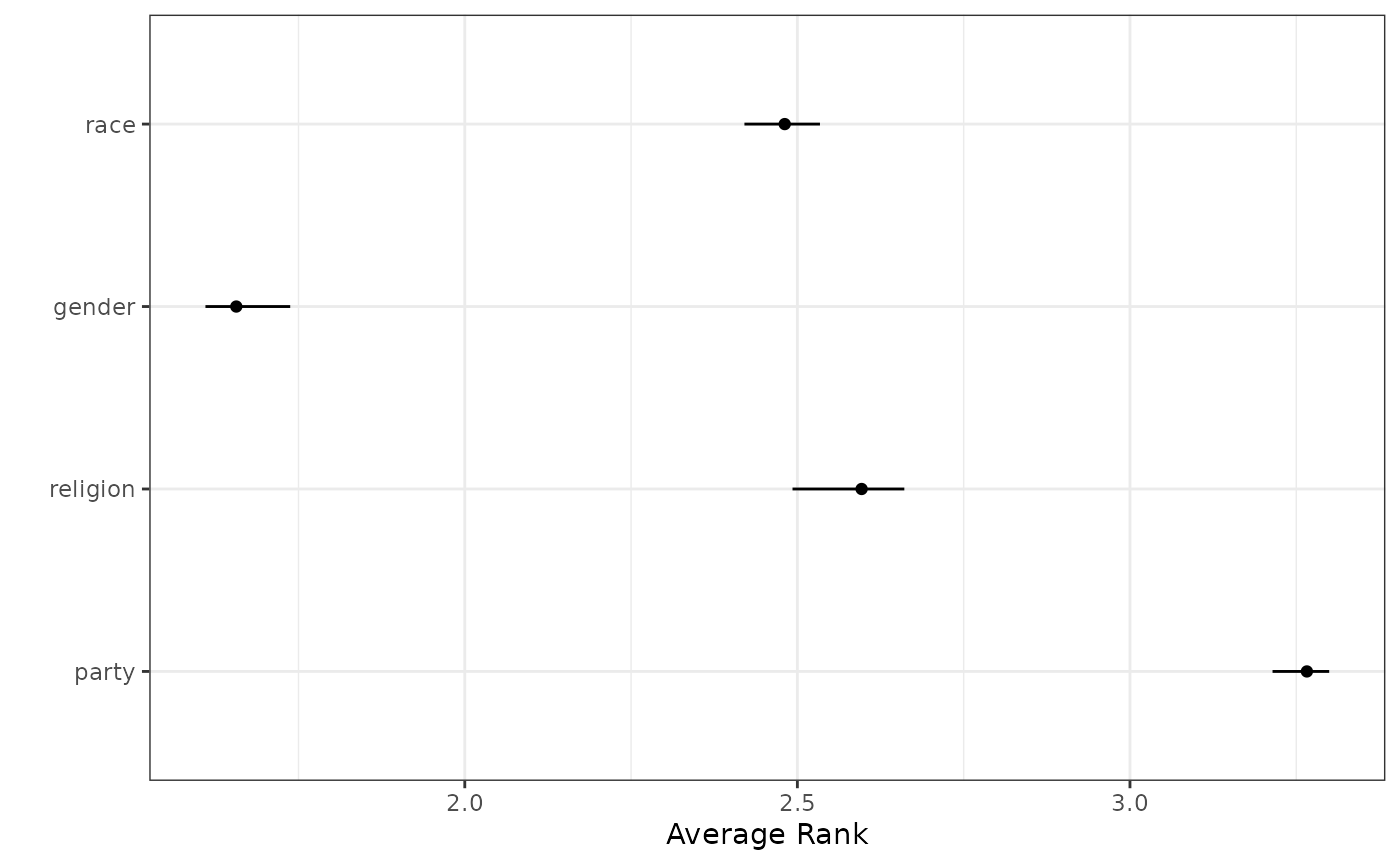
Weighting-Based Bias Correction via imprr_weights
The alternative method for bias correction is based on the idea of
inverse-probability weighting (IPW). imprr_weights
improves ranking data by computing
bias correction weights, which can be used to correct
for the bias in the IPW framework. The same arguments previously used
can be used as follows:
Because imprr_weights enumerates the full permutation
space, its computational cost grows quickly with J!. In
practice, this method is best suited to small or moderate ranking
questions; for larger J, imprr_direct or
imprr_direct_rcpp will usually be much more practical.
# Perform bias correction
out_weights <- imprr_weights(
  data = identity,
  J = 4,
  main_q = c("party", "religion", "gender", "race"),
  anc_correct = "anc_correct_identity"
)
## No weight column supplied; using equal weights for all observations.By default, imprr_weights assumes that the target
population is a set of non-random respondents. When researchers wish to
study the entire population as a target group, additional arguments must
be specified, including population and
assumption. For example, the uniform preference assumption
can be specified as follows:
# Perform bias correction with the uniform preference assumption
out_weights_uniform <- imprr_weights(
  data = identity,
  J = 4,
  main_q = c("party", "religion", "gender", "race"),
  anc_correct = "anc_correct_identity",
  population = "all",
  assumption = "uniform"
)
## population = 'all' with assumption = 'uniform' implies no correction; ignoring anc_correct and p_random.## No weight column supplied; using equal weights for all observations.Similarly, the contaminated sampling assumption can be specified as follows:
# Perform bias correction with the uniform preference assumption
out_weights_contaminated <- imprr_weights(
  data = identity,
  J = 4,
  main_q = c("party", "religion", "gender", "race"),
  anc_correct = "anc_correct_identity",
  population = "all",
  assumption = "contaminated"
)
## No weight column supplied; using equal weights for all observations.Results: Estimated Weights
The output of imprr_weights contains the set of weights
for all possible ranking profiles with J items. For
example, when J = 4, the set has
{1234, 1243, ..., 4321} and each profile now has an
estimated weight.
##    ranking   weights
## 1     1234 0.0000000
## 2     1243 0.0000000
## 3     1324 0.0000000
## 4     1342 0.0000000
## 5     1423 1.0158812
## 6     1432 0.4078355
## 7     2134 0.8582397
## 8     2143 0.8070574
## 9     2314 0.7456387
## 10    2341 0.0000000
## 11    2413 1.1316994
## 12    2431 0.5767371
## 13    3124 1.0238295
## 14    3142 0.5400194
## 15    3214 0.8251218
## 16    3241 0.0000000
## 17    3412 1.2733020
## 18    3421 1.0314721
## 19    4123 1.2628998
## 20    4132 1.1045545
## 21    4213 1.0388263
## 22    4231 0.4999637
## 23    4312 1.2711103
## 24    4321 1.0593130
Results: Estimated PMF with Bias Corrected Data
imprr_weights also returns the estimated probability
mass function of all ranking profiles before and after bias
correction.
##    ranking    prop_obs     prop_bc
## 1     1234 0.012939002 0.000000000
## 2     1243 0.010166359 0.000000000
## 3     1324 0.012939002 0.000000000
## 4     1342 0.006469501 0.000000000
## 5     1423 0.046210721 0.046944603
## 6     1432 0.018484288 0.007538549
## 7     2134 0.033271719 0.028555111
## 8     2143 0.030499076 0.024614506
## 9     2314 0.027726433 0.020673901
## 10    2341 0.005545287 0.000000000
## 11    2413 0.064695009 0.073215306
## 12    2431 0.022181146 0.012792690
## 13    3124 0.047134935 0.048258138
## 14    3142 0.021256932 0.011479155
## 15    3214 0.031423290 0.025928041
## 16    3241 0.011090573 0.000000000
## 17    3412 0.126617375 0.161222159
## 18    3421 0.048059150 0.049571673
## 19    4123 0.118299445 0.149400343
## 20    4132 0.059149723 0.065334095
## 21    4213 0.048983364 0.050885208
## 22    4231 0.020332717 0.010165620
## 23    4312 0.124768946 0.158595089
## 24    4321 0.051756007 0.054825814
Estimated Weights with Original Data
identity_w <- out_weights$results
head(identity_w)
## # A tibble: 6 × 19
## weights s_weight app_identity party religion gender race anc_identity
## <dbl> <dbl> <chr> <dbl> <dbl> <dbl> <dbl> <chr>
## 1 1.02 0.844 1423 1 4 2 3 1234
## 2 1.02 0.886 1423 1 4 2 3 1234
## 3 1.27 2.96 3412 3 4 1 2 1234
## 4 1.02 0.987 1423 1 4 2 3 1234
## 5 1.10 1.76 4132 4 1 3 2 1324
## 6 1.02 0.469 3124 3 1 2 4 1234
## # ℹ 11 more variables: household <dbl>, neighborhood <dbl>, city <dbl>,
## # state <dbl>, anc_correct_identity <dbl>, app_identity_recorded <chr>,
## # anc_identity_recorded <chr>, app_identity_row_rnd <chr>,
## # anc_identity_row_rnd <chr>, random_identity <dbl>, ranking <chr>
# save(identity_w, file = "data/identity_w.rda")